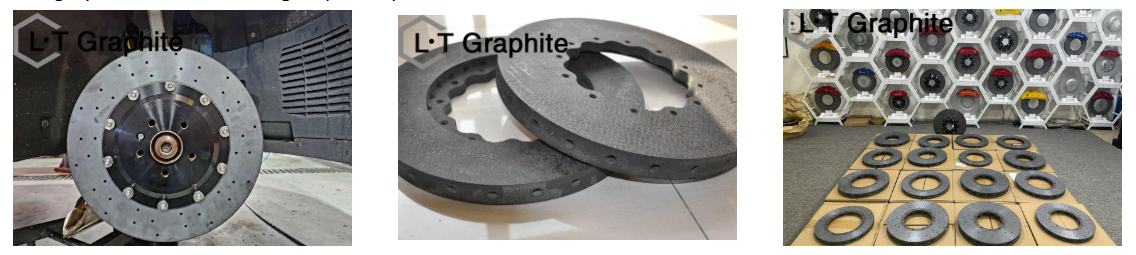
|


| Quantity: | |
|---|---|
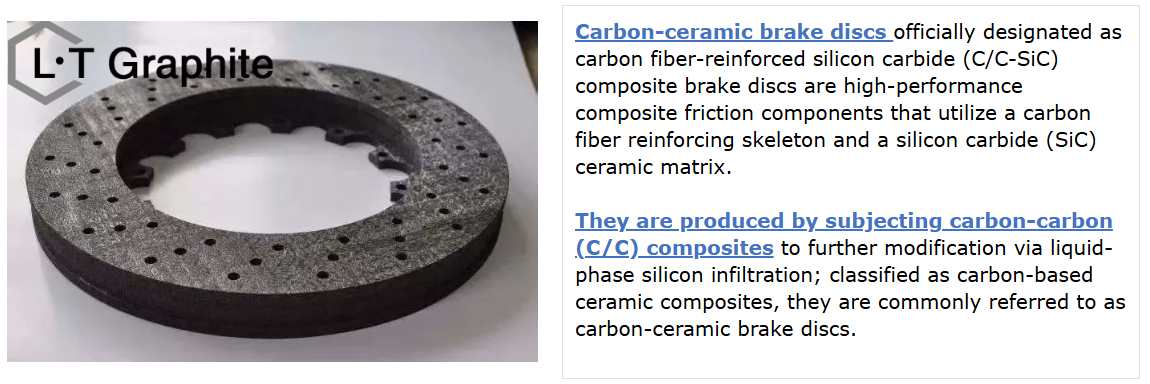
1. Preform Preparation:
Carbon fiber weaving or needle-punching of stacked layers to form the brake disc preform.
2. C/C Preform:
Chemical Vapor Infiltration (CVI) to deposit pyrolytic carbon within the fiber interstices, yielding a porous carbon-carbon (C/C) semi-finished product.
3. Molten Silicon Infiltration (Core Process): Processing in a vacuum furnace at approximately 1500-1700°C; molten silicon infiltrates the preform's pores and reacts with the carbon to form silicon carbide (SiC) ceramic, filling the voids and creating a composite structure of carbon fiber, carbon, and silicon carbide.
4. Machining:
Drilling, grinding, and dynamic balancing using diamond tools; application of an SiC coating to the friction surface (CCB); and assembly of the steel mounting bell.
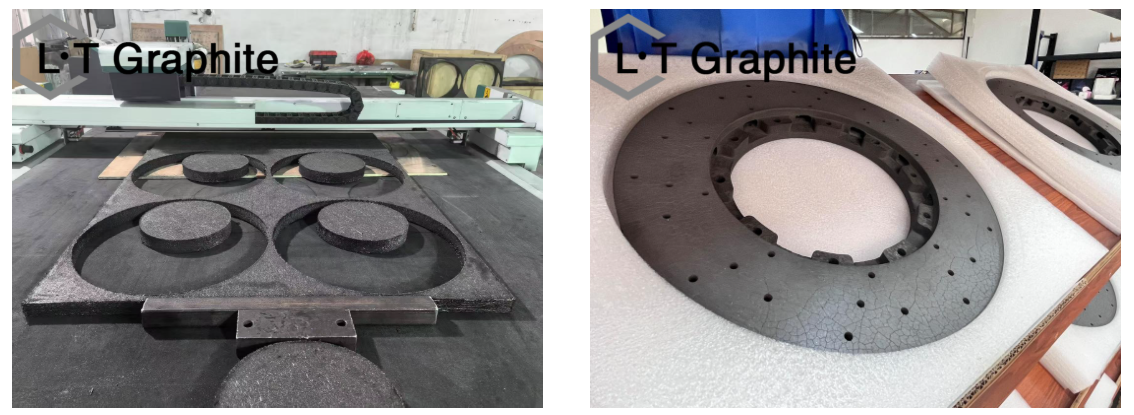
1. Lightweight design reduces unsprung mass:
With a density of only 1.9-2.3 g/cm³, the weight is just one-third to one-half that of cast iron discs. Reducing unsprung mass improves suspension response and steering agility; for new energy vehicles, it also helps extend driving range.
2. High-temperature resistance and strong resistance to thermal fade:
Capable of withstanding extreme temperatures of 1,200-1,400°C. The extremely low thermal expansion coefficient ensures the disc does not easily deform or warp during intense, continuous braking or long descents, maintaining stable braking force with virtually no thermal fade.
3. Stable friction performance across a wide temperature range:
suitable for public road use: Unlike C/C (carbon-carbon) discs, these provide a stable friction coefficient from a cold start, requiring no warm-up. Friction remains consistent even in wet, humid, or salt-spray conditions, making them suitable for both road and track use.
4. Wear resistance and long service life:
The high hardness of the silicon carbide matrix results in a wear rate far lower than that of cast iron discs. Under normal road conditions, the service life reaches 250,000-350,000 km-approaching the vehicle's entire lifespan. They produce minimal brake dust, keeping wheel rims cleaner.
5. Corrosion resistance and rust-free:
Containing no iron, they are impervious to rain, salt spray, and road de-icing agents, and do not develop rust like cast iron discs.
6. Excellent oxidation resistance:
The silicon carbide ceramic phase overcomes the critical flaw of C/C discs-which oxidize rapidly at high temperatures-making these discs suitable for prolonged operation in atmospheric environments.
 Applications
I. Automotive Sector
1. OEM Fitment (Mass-produced supercars / High-performance vehicles)
1)Luxury supercars:
Factory-installed options or standard equipment on models from automobile (PCCB carbon-ceramic brake system), Lamborghini, McLaren, etc.
2)Domestic high-performance new energy vehicles:
Offered as a high-performance option on select high-end, all-electric performance models.
Advantages:
Significantly reduces unsprung mass, improving acceleration, steering, and suspension response; resists brake fade during continuous, aggressive driving; discs do not rust and offer a service life far exceeding that of cast-iron discs.
2. Automotive Aftermarket Modifications
1)Dual-purpose (street and track) modified vehicles:
Suitable for both daily road driving and track use.
2)Note:
Must be paired with brake pads specifically designed for carbon-ceramic discs; standard metallic brake pads will scratch the silicon carbide disc surface.
II. Rail Transportation
High-speed EMUs (Electric Multiple Units), high-power locomotives, and select new rail vehicles:
Trial use or small-batch installation of carbon-ceramic brake discs.
Advantages: Lighter than cast-steel brake discs, reducing vehicle axle load; stable friction performance at high braking temperatures; resistant to thermal cracking; resistant to corrosion from rain and snow.
III. Aerospace Sector
aircraft braking components:
Select next-generation aircraft utilize carbon-ceramic brakes; compared to traditional C/C (carbon-carbon) brakes, they offer superior oxidation resistance and are less prone to oxidative wear at high temperatures during ground parking or repeated takeoffs and landings.
IV. Specialized Industrial Equipment
1. High-speed, heavy-load industrial brakes:
Braking mechanisms for high-speed rotary test rigs, large centrifuges, and specialized engineering machinery.
Operating conditions: Involves massive braking energy and extremely high instantaneous temperatures; standard metal brake discs are prone to thermal cracking and brake fade.
2. Weaponry and equipment:
Braking systems for select high-speed specialized combat vehicles.