|


| Quantity: | |
|---|---|
I. Equipment Interfaces
1. Pressure vessels, reactors, and storage tanks:
Shell nozzles, manways, and handholes utilize flange designs; opening the manway allows entry into the vessel for maintenance.
2. Pumps, fans, and compressors:
Inlet and outlet flanges facilitate equipment removal and replacement without the need to cut the piping.
3. Heat exchangers:
Channel head and shell head flanges; disassembly allows for cleaning of the tube bundle.
II. Piping Engineering (Primary Application)
1. Process piping:
Chemical plants, refineries, and coal-chemical facilities transporting media such as oil, steam, acids, and alkalis; pipe sections are joined via flanges to allow for disassembly during shutdowns for maintenance or valve replacement.
2. Thermal piping:
Power plants and district heating networks; high-temperature steam and hot water lines; valves and expansion joints are commonly fitted with flanges at both ends.
3. Water supply/drainage & Fire protection:
Large-scale municipal water supply and fire main lines; pump inlet and outlet connections.
4. Gas piping:
Industrial gas lines and interfaces for certain low-pressure gas equipment.
III. Valves and Pipe Fittings
Almost all industrial valves (gate valves, globe valves, ball valves) feature flanged bodies that bolt directly to pipeline flanges. Flange connections are also widely used for instrumentation and fittings such as strainers, flow meters, and flame arresters.
IV. Other Industries
1. Power generation:
Boilers, waste heat recovery piping, and desulfurization/denitrification units.
2. Shipbuilding:
Marine piping systems and seawater systems.
3. New energy:
Lithium-ion battery chemical processing lines; fluid handling equipment for photovoltaic and hydrogen energy systems.
4. Food and pharmaceuticals:
Stainless steel flanges and sanitary piping systems (using aseptic gaskets).
1. Easy alignment during installation:
Alignment simply requires positioning the two flanges and tightening the bolts evenly; the technical requirements for on-site installation are lower than those for welding.
2. Detachable connection:
Two pipe sections or pieces of equipment can be separated simply by tightening or loosening bolts, making maintenance, valve replacement, and equipment cleaning convenient-a major advantage of flanges over permanent welded joints.
3. Wide sealing capability:
By using various gaskets and sealing surface designs, they can accommodate conditions ranging from low-pressure/ambient-temperature environments to high-temperature, high-pressure, flammable, explosive, or toxic media applications.
4. High versatility:
They feature a high degree of standardization (e.g., GB, HG, ASME); flanges of the same specification are interchangeable, simplifying procurement and on-site installation.
5. Adjustable load-bearing capacity:
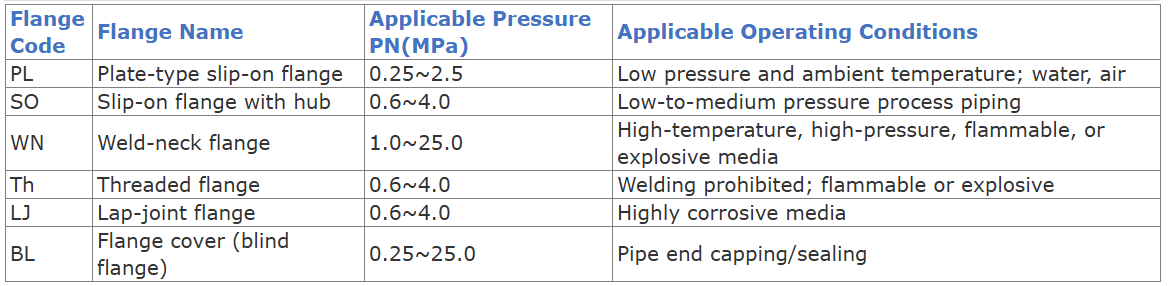
With various flange types (PL, SO, WN) and clearly defined strength ratings, there are suitable products for everything from low-pressure water piping to high-pressure hydrogenation units.