
 |


| Quantity: | |
|---|---|
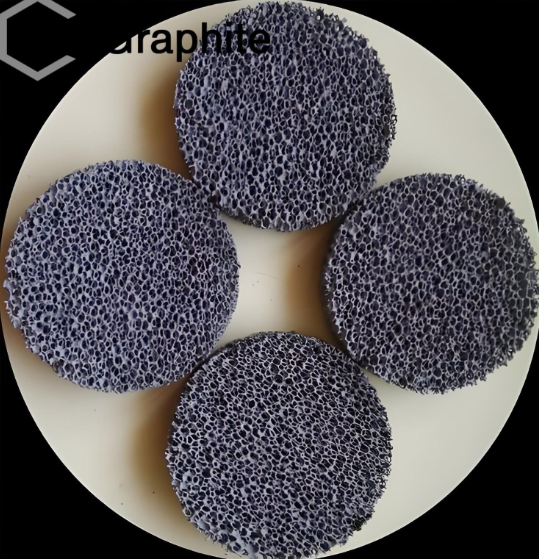
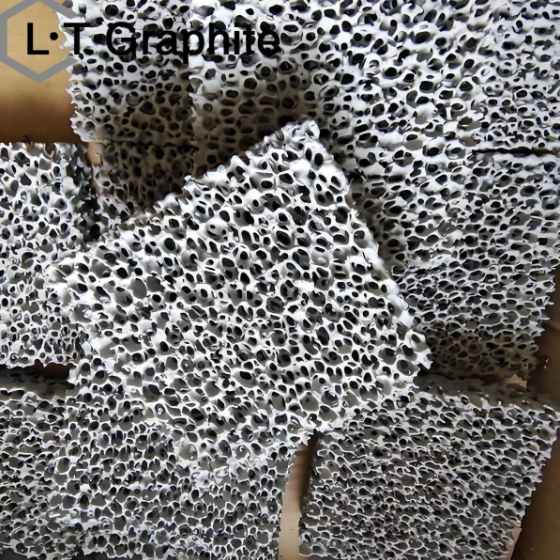
Foam ceramic filter is a porous ceramic device used to purify molten metal. Its core function is to efficiently remove non-metallic inclusions, bubbles, and oxides from molten metal during the casting process, thereby significantly improving the yield and internal quality of castings.
It uses polyurethane foam as a carrier and is manufactured through processes such as impregnation with ceramic slurry (e.g., alumina, silicon carbide, zirconium oxide, etc.), drying, and high-temperature firing, ultimately forming a ceramic product with a three-dimensional interconnected curved porous network skeleton structure.
This structure gives it an open porosity of 80%-90%, enabling deep purification of molten metal through multiple mechanisms such as mechanical interception, scum rectification, deep adsorption, and filter cake sieving.
Foam ceramic filters achieve high-efficiency purification through four mechanisms:
1.Filter cake screening: intercepting large particulate impurities;
2.Deep bed filtration: adsorbing tiny suspended solids within the pores;
3.Rectifying effect: converting turbulent flow into laminar flow, reducing molding impact;
4.Scum separation: promoting the flotation and separation of impurities.
Experiments show that its filtration efficiency can reach 95%, far exceeding the 67% of traditional fiber filters.
1. Foundry Industry: Molten Metal Purification.
The primary application of foam ceramic filters is in the casting processes of aluminum alloys, cast iron, cast steel, and copper alloys. They are used to filter non-metallic inclusions (such as oxides, slag, and sand particles) from the molten metal, significantly improving casting quality.
1) Aluminum Alloy Casting: Alumina (AlO) foam ceramic filters effectively remove micron-sized inclusions from molten aluminum, reducing porosity and slag defects. They are widely used in the production of precision components such as automotive wheel hubs and engine blocks.
2) Cast Iron and Cast Copper: Made of silicon carbide (SiC), these filters withstand temperatures up to 1550°C and are suitable for filtering high-density, high-thermal-shock molten copper and iron. They are particularly useful in high-requirement castings such as marine turbines and chemical valves, extending their service life.
3) Cast Steel and Stainless Steel: Zirconia (ZrO) is used, with a temperature resistance exceeding 1700°C. It efficiently filters out minute inclusions in molten steel, reduces surface defects, minimizes subsequent processing allowances, and improves yield.
2. Automotive Exhaust Purification: Catalyst Carrier.
Foam ceramics, due to their large specific surface area and good thermal stability, are widely used as carrier materials for automotive exhaust catalytic converters.
1) After coating with precious metal catalysts, CO, HC, and NOx can be converted into harmless gases, with a conversion rate exceeding 90%;
2) In diesel vehicles, the purification rate of carbon particles exceeds 50%, and regeneration can be achieved through catalytic oxidation or electronically controlled combustion, enabling long-term use.
3. Environmental Protection and Waste Gas Treatment:
1) Used as a high-temperature filter medium in industrial flue gas dust removal, desulfurization, and denitrification systems;
2) Removes suspended solids and oil in wastewater treatment, improving effluent quality.
4. Other High-Tech Fields
1) Catalyst Supports: Used in petrochemical refining, organic waste gas treatment, and other reaction processes;
2) Thermal and Sound Insulation Materials: Utilizing their porous structure to achieve heat preservation and noise absorption in high-temperature furnaces;
3) Biochemistry and Medicine: Serving as bioreactor supports or drug release carriers.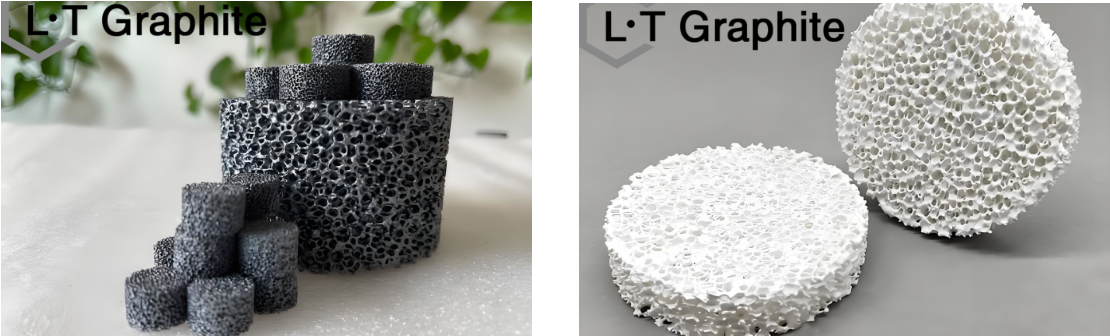
Cast alloy types | recommend | Recommended aperture (PPI) | Applicable Scenarios |
Ductile iron | SiC | 10–15 PPI | Due to the presence of numerous impurities, large-diameter pores are required to prevent clogging, effectively remove oxide inclusions, and improve the stability of spheroidization rate. |
Gray cast iron / malleable cast iron | SiC | 15–20 PPI | With a medium impurity content, 20 PPI balances filtration efficiency and molten metal flow rate. |
Cast steel / Stainless steel | ZrO2 | 10–15 PPI | High-temperature molten steel (≤1700℃) contains many fine inclusions, requiring high temperature resistance and strong filtration capacity. |
Copper alloy / brass / bronze | SiC | 20–30 PPI | It has good fluidity, is suitable for medium and fine pore sizes, and effectively filters out micron-sized inclusions. |
Aluminum alloy / Aluminum-magnesium alloy | Al2O3 | 20–30 PPI | For low-density molten metal, a starting point of 20 PPI is commonly used, while 30 PPI or higher is recommended for high-quality castings. |
Continuous casting and rolling of aluminum materials | Al2O3 | 30–60 PPI | High purity requirements necessitate deep filtration with fine pores to prevent pores and inclusions. |
High-temperature alloys (nickel-based, cobalt-based) | ZrO2 | 10–15 PPI | High-temperature, high-activity alloys require filter materials with extremely high chemical stability. |
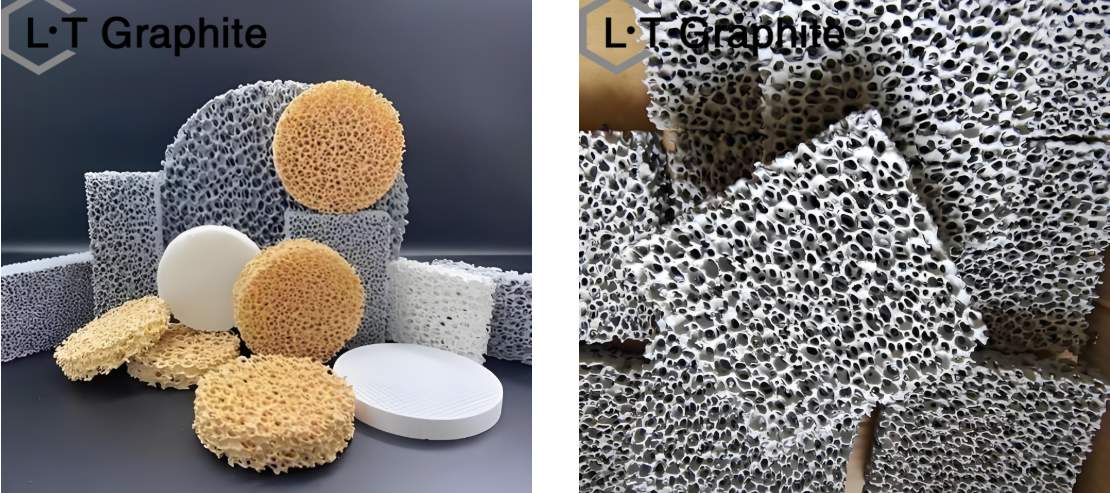
1. High Porosity and Specific Surface Area: Foam ceramic filters possess a three-dimensional, interconnected, porous network structure with a porosity typically between 80% and 90%, and some products reaching 20% to 95%. This high porosity endows them with an extremely large specific surface area. The larger the surface area per unit mass or volume, the stronger the ability to adsorb and intercept impurities, thus significantly improving filtration efficiency.
2. Room Temperature Strength: To ensure that it does not break or crumble during transportation, handling, and installation, foam ceramic filters must possess good room temperature mechanical strength. Generally, its room temperature compressive strength is required to be ≥ 0.8-1.5 MPa, with specific values varying depending on the material and application. For example, filters made of silicon carbide have higher strength and are suitable for heavy-duty applications.
3. High Temperature Strength and Thermal Shock Resistance: During the casting of high-temperature molten metals (such as steel and aluminum), the filters must withstand severe thermal shock. Its thermal shock resistance refers to the material's ability to withstand thermal cycling from 1100ºC to room temperature without cracking or peeling. The national standard GB/T 25139-2010 specifies clear testing requirements for the thermal shock resistance of silicon carbide foam ceramics to ensure structural integrity under extreme conditions.
4. Refractoriness
5. Chemical Stability
Foam ceramic filters do not chemically react with molten metal at high temperatures, will not contaminate the molten metal or release gases, ensuring the stability of the alloy composition. Materials such as silicon carbide and zirconium oxide exhibit good corrosion resistance to acidic and alkaline molten metals.
6. Resistance to Molten Metal Erosion
During casting, the molten metal flows rapidly and has a strong impact force. High-quality foam ceramic filters possess high erosion resistance, remaining intact and undeformed even under the impact of 1700kg of molten iron and a 500mm pressure head, ensuring continuous and stable operation.
7. Low thermal conductivity and good thermal insulation performance: Due to the presence of closed pores in its porous structure, foam ceramics have a low thermal conductivity and can be used as an energy-saving thermal insulation material to reduce heat loss.


